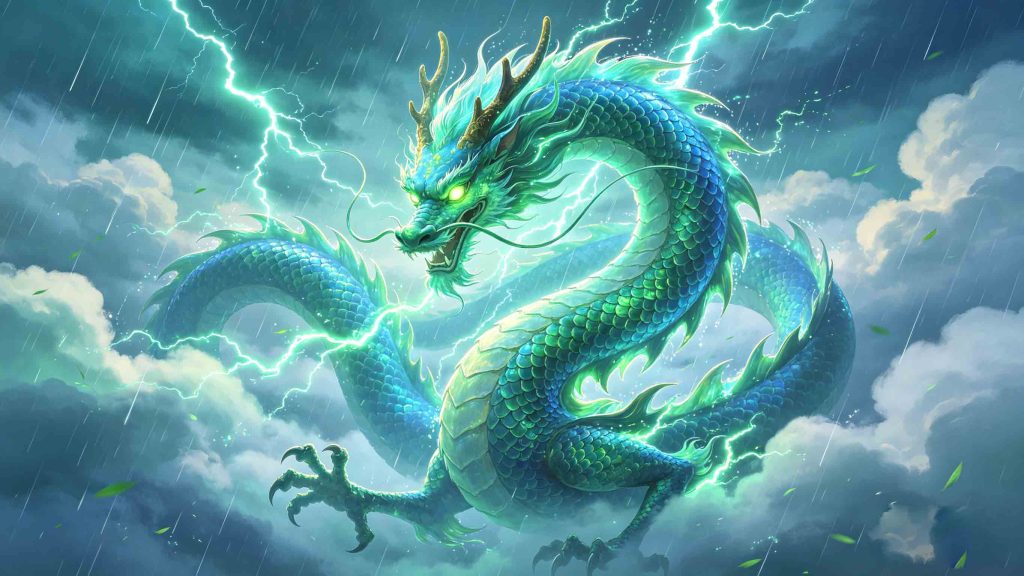
When most people think of Chinese mythology dragons, they imagine fire-breathing beasts hoarding treasure. But the Azure Dragon — known as 青龙 (Qīng Lóng) — occupies a uniquely sacred position.
This celestial guardian is one of four divine protectors that govern the heavens, the seasons, and the balance of yin and yang. Understanding it means understanding a cornerstone of Chinese cultural thought that shaped imperial politics, astronomy, and zodiac traditions for over three millennia.
Unlike common misconceptions of dragons as chaotic creatures, this celestial guardian represents order, vitality, and the life-giving energy of spring. As guardian of the eastern quadrant of the sky, it presides over renewal and the wood element — the force behind all growing things.
—
What Is the Azure Dragon in Chinese Mythology?
The Azure Dragon (Qīng Lóng) is the mythological guardian of the East in the ancient Four Celestial Guardians (四象, Sì Xiàng). Its name translates to “Blue Dragon” or “Green Dragon,” rendered as “Azure” to reflect its celestial significance.
This divine being is depicted as a serpentine dragon with blue-green scales, curved horns, and powerful claws. It floats through clouds surrounded by rain and thunder that nourish the earth — never breathing fire or hoarding treasure.
—
The Four Celestial Guardians
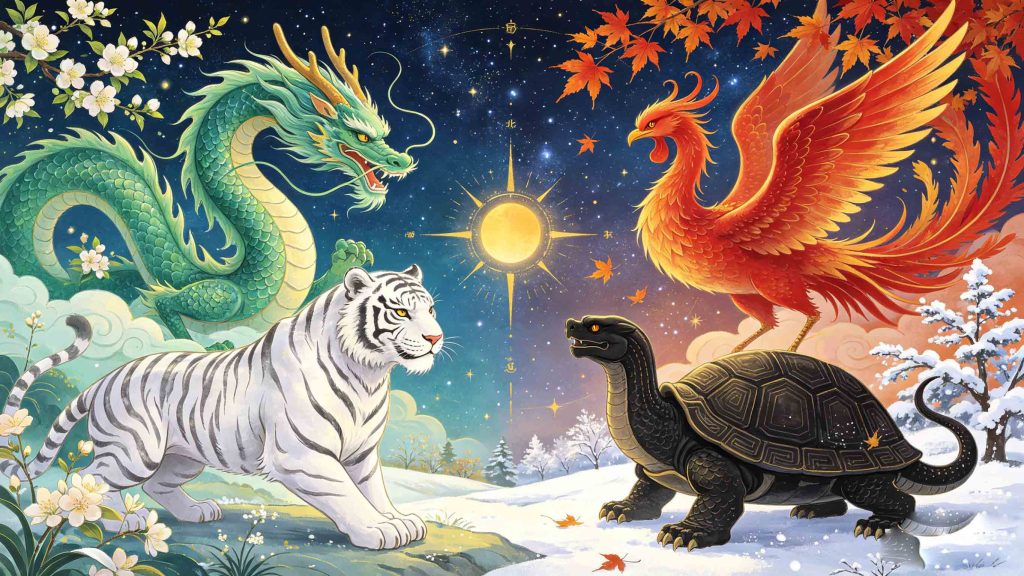
The Four Celestial Guardians (四象) form one of the most enduring cosmological frameworks in Chinese mythology. Each guardian embodies not just a direction, but elemental forces, seasonal cycles, and philosophical principles:
– Azure Dragon — East, spring, wood element, growth, and yang energy
– White Tiger (白虎) — West, autumn, metal element, military power
– Vermilion Bird (朱雀) — South, summer, fire element, warmth and spiritual ascension
– Black Tortoise (玄武) — North, winter, water element, longevity and wisdom
Together, these four form a continuous cycle: wood feeds fire, fire creates earth, earth forms metal, metal holds water, and water nourishes wood. It stands at the eastern gateway, where this cycle renews each spring.
Spring, Wood Element, and Life Energy
In the Five Elements (五行, Wǔ Xíng) system, the Azure Dragon embodies the wood element. Wood is the element of spring, growth, and upward energy — the force that pushes seedlings through soil and sap through trees.
Ancient Chinese texts describe this eastern guardian as the embodiment of 生气 (shēng qì), or “life energy.” When its stars rose at sunset, it signaled spring — the most auspicious season for new ventures, planting crops, and undertaking anything requiring renewed vigor.
The dragon was believed to be a conduit of celestial qi, descending to bring rain and good fortune. Prayers to this divine creature were common at planting time, asking for timely rains and abundant harvests.
—
Azure Dragon Stars: Chinese Astrology and the Lunar Mansions
The Azure Dragon Stars (苍龙星宿) form one of four divisions of the Chinese zodiac’s 28 lunar mansions (二十八宿). Its seven mansions are:
– 角宿 (Horn) — New beginnings
– 亢宿 (Neck) — Vitality
– 氐宿 (Root) — Celestial foundation
– 房宿 (Room) — Stored celestial energy
– 心宿 (Heart) — Imperial authority (includes the star Antares)
– 尾宿 (Tail) — Strategy and cunning
– 箕宿 (Winnowing Basket) — Wind and energy dispersal
The position of these stars determined the season and guided astrological predictions. When these stars were visible in the east at sunset, it was spring. The Heart mansion was particularly significant — its star Antares was considered the dragon’s heart and was closely linked to imperial power.
—
Guardian Statues in Chinese Architecture
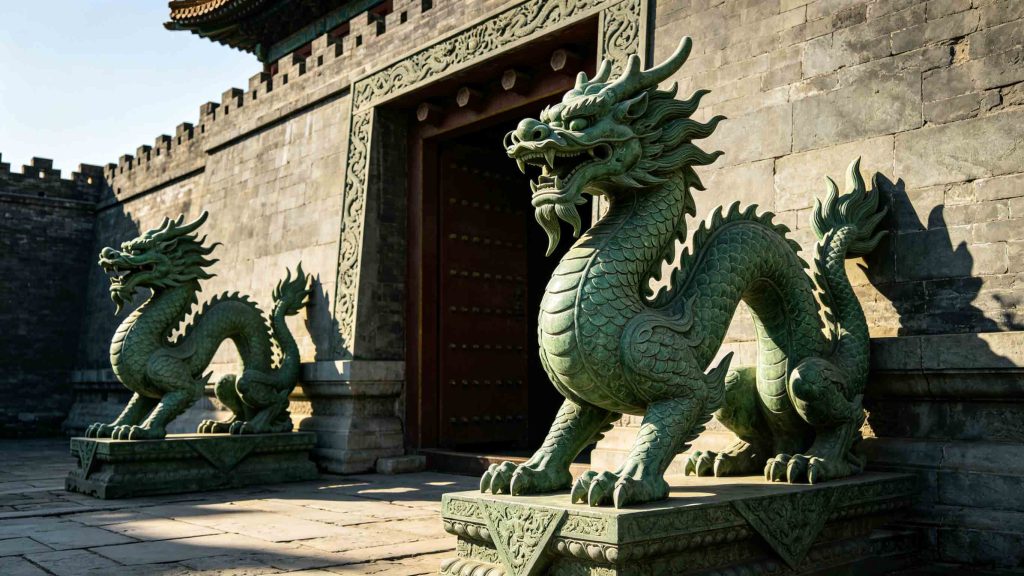
Walk through the entrance of any significant traditional Chinese building — a temple, a tomb, an imperial palace — and you will likely encounter the Four Celestial Guardian statues flanking the gates. These sculptures, known as shichen (石沉), have stood watch for over two thousand years.
Its statue typically occupies the eastern gate, facing the direction it protects. Made from stone, bronze, or ceramic, these dragons are depicted in a powerful but controlled posture — coiling slightly, head raised, often clutching a pearl (a symbol of spiritual energy and rain).
In the Chinese cosmological worldview, buildings were vulnerable to malevolent spiritual forces. The Four Guardians formed a protective perimeter. This guardian intercepted threats arriving from the sunrise direction. This tradition continued through the Han, Tang, Ming, and Qing dynasties. The Ming Xiaoling Mausoleum and the Forbidden City in Beijing both feature magnificent eastern dragon guardian sculptures.
—
The Battle with the Demon King
One of the most dramatic stories involves the this guardian’s legendary battle against demonic forces. In one popular myth, it lived in the Eastern Sea and protected coastal regions from Gong Gong (共工), the water demon who shattered the mountain supporting the sky, causing catastrophic floods.
In this cosmic conflict, the Azure Dragon fought to protect humanity. Depending on the version, the dragon either defeated the demon, absorbed its powers, or sacrificed itself to create pathways for floodwaters to recede — its body becoming the landscape it once protected.
These battle myths encode a profound meaning: its victory represents the triumph of cultivation over destruction, of life over death, of cosmic order over chaos. The dragon is the eternal guardian standing between civilization and annihilation.
—
Emperor’s Symbol: Imperial Authority
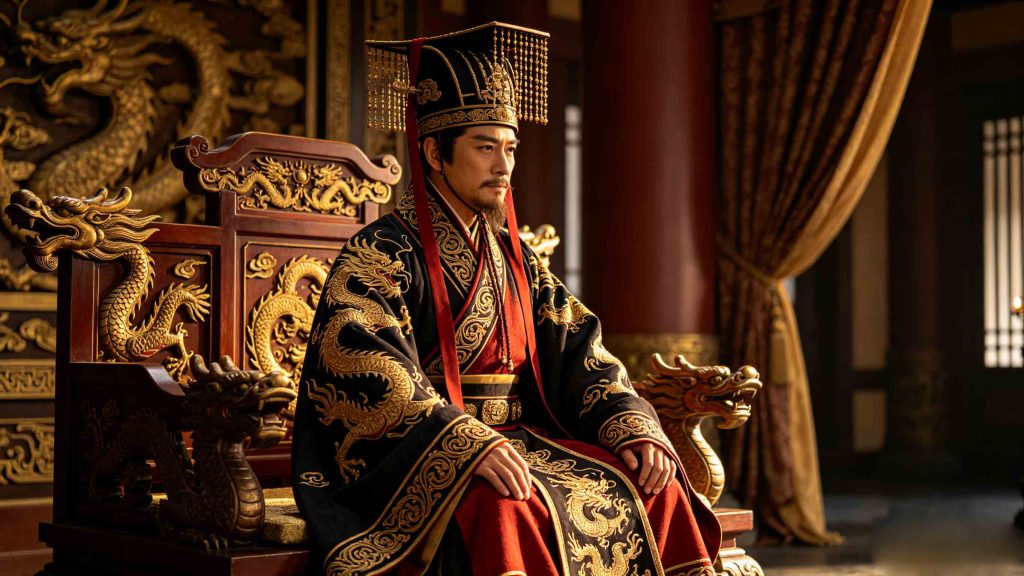
By the Han Dynasty (206 BCE – 220 CE), the Azure Dragon had become firmly associated with imperial power. The Emperor was called the “True Dragon Son of Heaven” (真龙天子) — a human incarnation of the celestial dragon’s authority.
The distinction between it and ordinary dragons became significant. The common dragon symbolized general power and fortune. This sacred dragon specifically represented righteous exercise of power — the emperor’s duty to protect his people, bring rain, ensure good harvests, and maintain cosmic balance.
This is why the five-clawed dragon (五爪龙) became restricted to imperial use. Commoners who used the dragon’s image could be punished by death. Its imagery adorned the Emperor’s throne, robes, banners, and palace architecture.
—
Azure Dragon vs. Regular Chinese Dragons: What’s the Difference?
This is the most common question about the Azure Dragon. While all Chinese dragons share a serpentine form, the Azure Dragon is specifically one of the Four Celestial Guardians:
| Feature | Azure Dragon | Regular Chinese Dragon |
|—|—|—|
| Direction | East exclusively | No fixed direction |
| Element | Wood, spring | Varies (water, etc.) |
| Role | Celestial guardian | Symbol of power/fortune |
| Astronomy | Specific constellation | Not astronomical |
| Color | Blue-green (青) | Gold, black, etc. |
| Imperial | Emperor’s righteous power | General imperial symbol |
Every Azure Dragon is a Chinese dragon, but not every Chinese dragon is an Azure Dragon. The distinction is the difference between a general category and a specific divine role.
—
The Azure Dragon’s Enduring Legacy
The Azure Dragon remains a living presence in modern Chinese culture. Dragon boat races invoke its protective energy. Its image appears in corporate logos, video games, and fashion. In feng shui, placing Azure Dragon imagery in the eastern section of a home activates wood energy and promotes growth.
For over three millennia, this celestial guardian shaped how the Chinese understood the sky, seasons, power, and nature’s balance. In ancient Chinese thought, the cosmic and terrestrial were never truly separate — the dragon in the sky and the dragon at the temple gate were the same guardian presence.
Frequently Asked Questions About the Azure Dragon
What does the Azure Dragon represent in Chinese mythology?
The Azure Dragon (青龙, Qing Long) represents the guardian of the East, the wood element, and the season of spring. It is one of the Four Celestial Guardians and symbolizes growth, vitality, imperial authority, and protection against evil. It is closely associated with rain, life energy (qi), and nature’s renewal.
How is the Azure Dragon different from other Chinese dragons?
While all Chinese dragons share a serpentine form, this divine beast is specifically one of the Four Celestial Guardians. Regular dragons are general symbols of power and fortune, whereas the Azure Dragon has a defined astronomical identity, elemental role (wood/spring), guardian function, and distinct blue-green coloring. It corresponds to specific constellations rather than being a general mythical creature.
What are the Azure Dragon Stars in Chinese astrology?
The Azure Dragon Stars (苍龙星宿) are seven lunar mansions forming the eastern division of the 28-moon lodge system. They include Horn, Neck, Root, Room, Heart, Tail, and Winnowing Basket mansions. Their position signaled spring’s arrival and guided agricultural and political predictions. The Heart mansion’s star Antares was particularly linked to imperial power.
Why is the Azure Dragon a symbol of Chinese emperors?
From the Han Dynasty onward, this eastern guardian represented righteous imperial authority — not just power, but the benevolent duty to protect people and maintain cosmic balance. The Emperor was called the “True Dragon Son of Heaven,” drawing directly on this symbolism. The five-clawed Azure Dragon became restricted to imperial use.
What role does the Azure Dragon play in Chinese architecture?
In traditional Chinese architecture, celestial dragon guardian statues stand at the eastern gate of temples, tombs, and palaces as part of the Four Guardian sculptures. These 2,000-year-old sculptures protect buildings from malevolent spiritual forces arriving from the east. This practice continues in modern feng shui applications.
What is the myth of the Azure Dragon’s battle against the Demon King?
In Chinese mythology, this mythic dragon battles demons threatening humanity — most notably the water demon Gong Gong, whose floods threatened civilization. The dragon’s victory represents the triumph of cosmic order over chaos. In some versions, the dragon sacrificed itself to save humanity, transforming into geographical features like rivers or mountains.
– Britannica: Chinese Dragons
– Encyclopedia Britannica: Four Symbols (Chinese Constellations)
– Metropolitan Museum of Art: Dragon in Chinese Art
– Stanford Encyclopedia of Philosophy: Confucianism and the Five Elements
– Chinese Astrology: The 28 Lunar Mansions
—
Related Articles
– Chinese Mythology White Tiger: The Western Guardian — Discover the fierce White Tiger guardian of the West
– Chinese Mythology Vermilion Bird: The Southern Fire Guardian — Explore the celestial guardian of summer
– Chinese Mythology Black Tortoise: The Northern Water Guardian — Meet the mysterious Black Tortoise guardian
– Chinese Dragon Symbols: Complete Guide to Dragon Types — A guide to all major types of Chinese dragons
– Four Celestial Guardians: The Complete Guide to 四象 — Everything about the Four Symbols
Enjoyed this story? Share it!
🐦 Share on Twitter📚 Related Books
Explore more Chinese mythology stories in our curated collection